
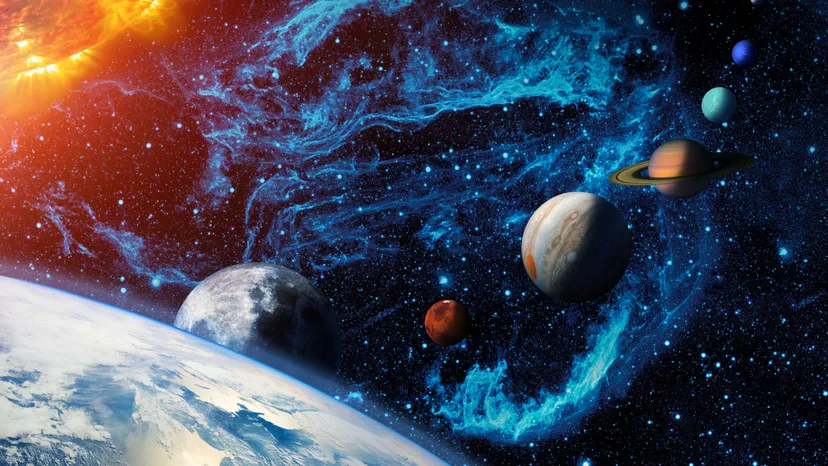
A reflection from the House of Wisdom on the dynamic, living nature of our planet.
From the scale of the cosmos, we now zoom in to our home: a pale blue dot suspended in a sunbeam. Our planet, Earth. It can be easy to think of our world as a static stage upon which the drama of life unfolds. But the story of our planet is one of relentless, dynamic, and often violent change. The only constant is change itself, a process of perpetual turning and alteration—taqleeb—governed by precise and unwavering physical laws. This constant activity is a sign of a living, sustaining power, as described in the Quran:
كُلَّ يَوْمٍ هُوَ فِي شَأْنٍ
“Every day He is in [a new] matter of state.” (Surah Ar-Rahman, 55:29)
The history of Earth is a profound illustration of this verse. It is not a story of placid tranquility, but of constant creation and re-creation.
A Violent Birth, A Precise Orbit
Our solar system began to form around 4.6 billion years ago from a swirling cloud of gas and dust. Our Earth formed shortly after, but its early life was anything but peaceful.
In its infancy, our planet was struck by a rogue protoplanet named Theia. This cataclysmic event, the Giant Impact, blasted a colossal amount of debris into orbit, which eventually coalesced to form our Moon. This violent birth was paradoxically one of the most important events for the future of life. The Moon’s gravitational pull acts as a stabilizer, preventing our planet from wobbling wildly on its axis and allowing for a climate stable enough to support complex organisms.
This points to a profound principle, a lesson written into the very geology of our world. What appears to us as a destructive event can, within a larger plan, be a source of profound good. It is a physical manifestation of a spiritual truth:
…وَعَسَىٰ أَن تَكْرَهُوا شَيْئًا وَهُوَ خَيْرٌ لَّكُمْ ۖ وَعَسَىٰ أَن تُحِبُّوا شَيْئًا وَهُوَ شَرٌّ لَّكُمْ ۗ وَاللَّهُ يَعْلَمُ وَأَنتُمْ لَا تَعْلَمُونَ
“…But perhaps you hate a thing and it is good for you; and perhaps you love a thing and it is bad for you. And Allah Knows, while you know not.” (Surah Al-Baqarah, 2:216)
Our planet’s stability is not absolute. Its relationship with the Sun is a complex dance governed by the Milankovitch cycles—subtle shifts in our orbit’s shape, tilt, and wobble. These cycles alter the solar energy reaching Earth, driving long-term climate changes like the advance and retreat of ice sheets. Again, we see a cycle of apparent hardship leading to new opportunities and shaping the course of life. This intricate dance also explains why we only see one side of the Moon (due to tidal locking) and is proven by the majestic swing of a Foucault Pendulum, which reveals not the pendulum’s movement, but the constant, silent rotation of the Earth beneath it.
The Breath of Life and the Shifting Continents
The Earth’s dynamism is not limited to its orbit. The ground beneath our feet is a mosaic of massive tectonic plates, constantly shifting, grinding, and pulling apart, driven by the heat of the planet’s core. This process assembled and broke apart supercontinents like Pangea and raised the mighty Himalayan mountains through the collision of the Indian and Asian plates—a process still ongoing today.
But perhaps the most profound transformation came not from geology, but from biology. For the first two billion years of Earth’s history, the atmosphere was largely devoid of free oxygen. Then, around 2.4 billion years ago, tiny microbes called cyanobacteria developed a revolutionary new process: oxygenic photosynthesis. They began to release oxygen as a waste product, leading to the Great Oxygenation Event.
This fundamentally and permanently changed the chemistry of our entire planet. For the anaerobic life that had dominated until then, this was a global catastrophe. But for a new kind of life that could harness the power of oxygen, it was the dawn of a new era.
The very air we breathe is a gift from the planet’s earliest, simplest life forms. They terraformed an entire world. This reveals a deep and powerful truth: life is not merely a passenger on planet Earth; it is a geological force in its own right. The planet shapes life, and life, in turn, shapes the planet. This profound interconnectedness, where biology and geology are woven into a single, self-regulating system, is one of the most powerful signs of Tawhid—the principle of Divine Unity—reflected in the unity and coherence of His creation. Our world is in constant, dynamic flux, a system of perpetual change governed by precise laws. It is a sign of a living, active, and purposeful creation.