
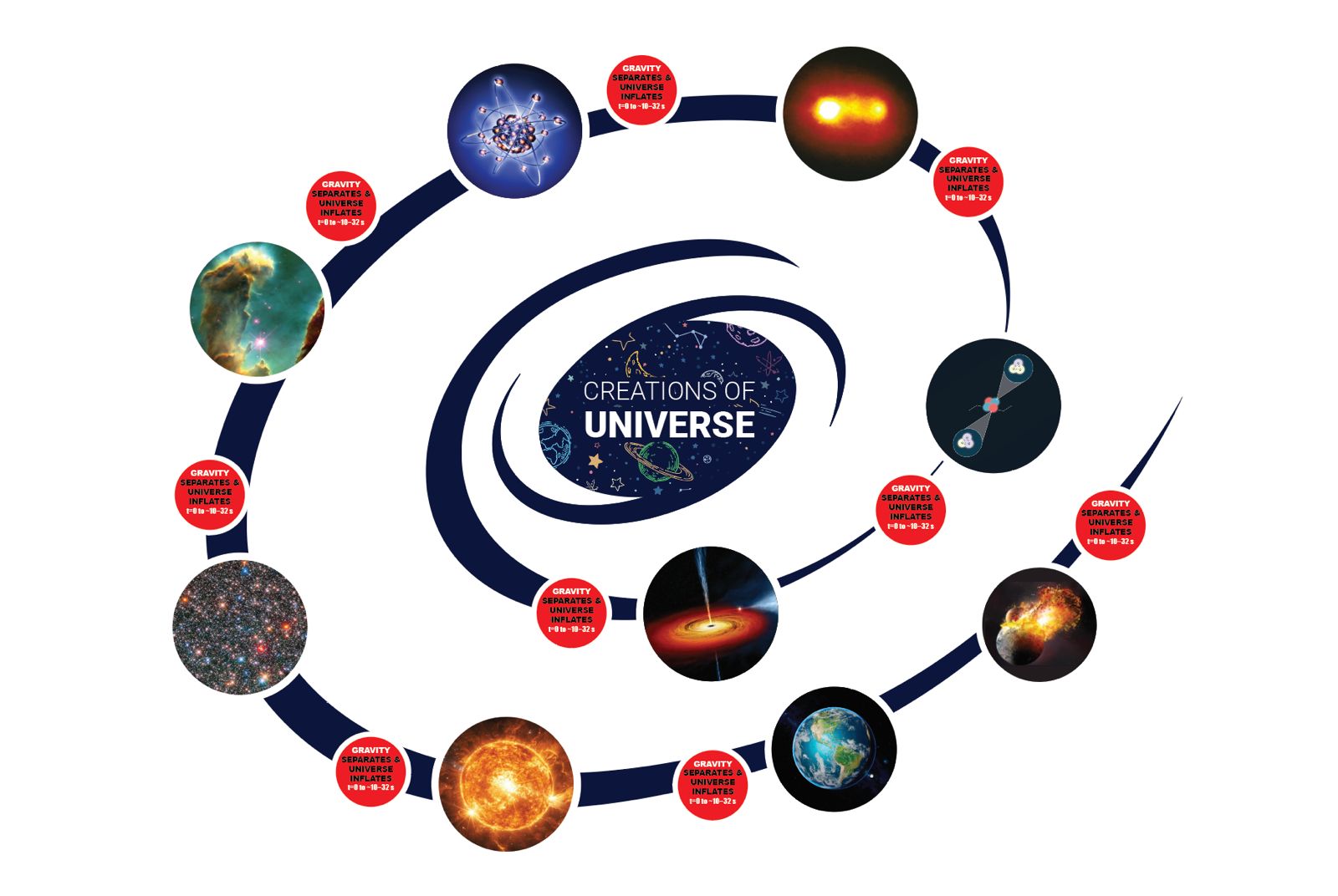
Our journey begins at the dawn of time itself. This episode explores the awe-inspiring origin of everything we know. Visitors will witness the moment of the Big Bang, where all space, time, and energy erupted from an infinitesimal point. We explore how the fundamental forces of nature, like gravity, separated and began to sculpt the cosmos. Here, learners will meet the universe’s first, most basic building blocks—quarks and leptons—and understand how figures like Paul Dirac conceptually predicted antimatter. The narrative unfolds to show how these particles coalesced, leading to the ignition of the first stars and the formation of majestic galaxies, setting the stage for everything that follows.
From the cosmic scale, we zoom into our own stellar neighborhood and the violent, beautiful birth of our world. This episode tells the story of early Earth, a tumultuous planet shaped by intense vulcanism and meteorite impacts. Visitors will experience the “Giant Impact Hypothesis,” the cataclysmic collision that formed our Moon and stabilized Earth’s tilt, making it habitable. We will journey through the formation of the first atmosphere and the condensing of water vapor into the primordial oceans—the cradle of life. This is where we investigate one of science’s greatest mysteries: abiogenesis, the emergence of the first living cells from non-living chemistry.
Life did not just begin; it began to change. This episode is an epic saga of evolution, adaptation, and extinction. We start with the “Cambrian Explosion,” a period of rapid diversification where most major animal body plans emerged. Visitors will walk among ancient giants, from the age of dinosaurs to massive megafauna. Crucially, this episode also explores the “great filters” of history—the mass extinction events, like the Permian “Great Dying” and the K-Pg impact that wiped out the non-avian dinosaurs. It puts our own existence into perspective by exploring the profound fact that over 99% of all species that have ever lived are now extinct..
With the stage set, humanity enters the story. This episode covers the dawn of human civilization, driven by revolutionary “big ideas.” We explore the Neolithic Revolution, where the domestication of plants and animals allowed humans to settle for the first time. This led to the rise of the world’s first great urban centers in Mesopotamia, Egypt, and here in the Indus Valley (Mohenjo-daro, Harappa). Visitors will discover the power of foundational inventions like the wheel and, most importantly, the development of writing, which allowed for laws, history, and complex knowledge to be preserved and passed on.
During a time when parts of Europe were in a dark age, a brilliant torch of knowledge was lit across the Islamic world. This episode celebrates the Islamic Golden Age, a remarkable period of intellectual synthesis and discovery. We visit Baghdad’s legendary House of Wisdom (Bayt al-Hikmah) and the vibrant courts of Al-Andalus (Islamic Spain). Here, scholars didn’t just preserve Greek, Persian, and Indian knowledge; they built upon it, giving the world algebra, advancing medicine, developing optics, creating astoundingly accurate world maps, and fostering a culture of exploration that expanded the known world.
The torch of knowledge is passed and transforms into an engine of global change. This episode charts the course from the European Renaissance, fueled by the rediscovery of classical and Islamic scholarship, to the world-altering Industrial Revolutions. We explore how the scientific method provided a new way of understanding the universe, how the printing press made knowledge accessible like never before, and how the steam engine and mechanization remade society, creating immense new opportunities and unprecedented new challenges that set the stage for the modern world.
We conclude our journey in the present and look to the future. This episode places us in the “Anthropocene”—the age where human activity is the dominant force shaping the planet. We confront our greatest challenges: climate change, resource scarcity, and the “digital divide.” We also explore our most powerful tools: Artificial Intelligence, genetic engineering, and a globally interconnected digital society. The core theme is our evolving, symbiotic relationship with technology. Are we the masters of our tools, or are we co-evolving with them into a new kind of hybrid existence? This final stage is a space for reflection, critical thinking, and inspiring visitors to shape a wise and sustainable future.